
Alberta Opens Its Online Gambling Market July 13 – and the Hard Part Starts After


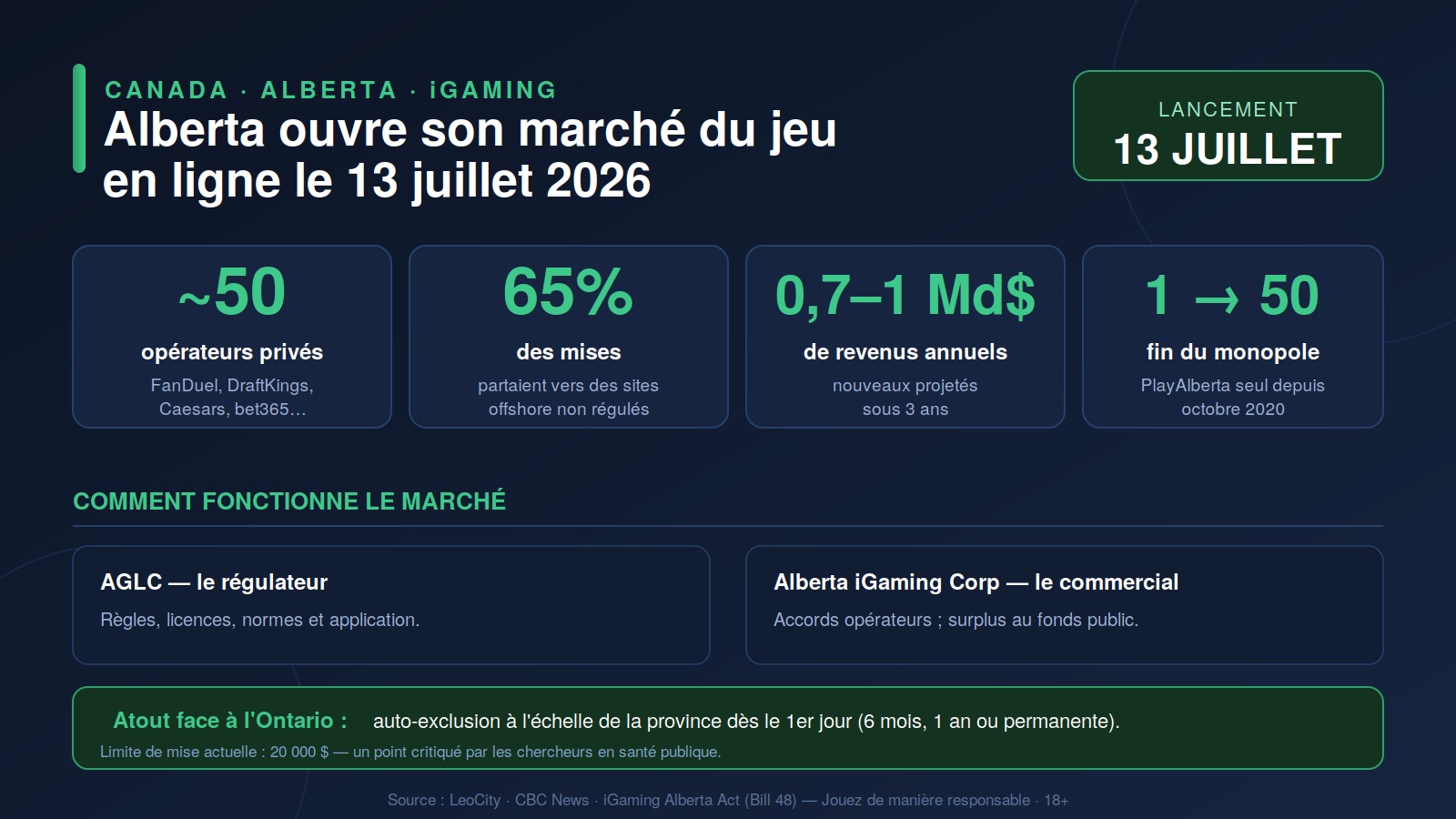
Alberta will switch on Canada’s second open online gambling market on July 13, 2026, ending nearly six years in which a single government-run site was the only legal place to bet online in the province. Close to fifty private operators are lined up for licences, including the names most Canadians already recognize from Ontario — FanDuel, DraftKings, Caesars and bet365 among them. As reported by CUMTN, the firm date has finally given operators something they spent most of last year without: a fixed point to build toward. The shift is large, the timeline is now firm, and the questions that lawmakers deferred during the bill’s passage are about to land all at once.
From one platform to fifty
Until this summer, anyone in Alberta who wanted a regulated online wager had exactly one option: PlayAlberta, the platform run by Alberta Gaming, Liquor and Cannabis since October 2020. That monopoly never reflected where the money was actually going. Service Alberta Minister Dale Nally has put the share of online gambling flowing through unregulated offshore sites at roughly 65 per cent, according to CBC News, and some industry estimates run higher still. Every dollar wagered on those sites sat outside provincial oversight and outside the provincial treasury.
The iGaming Alberta Act — Bill 48 — was built to pull that activity back inside the fence. It received royal assent on May 12, 2025, after passing three readings in about six weeks. Rather than expand gambling, Nally argued repeatedly through the spring of 2025, the law was meant to make the gambling that already happens safer and to keep its revenue in the province. The provincial framing has stayed consistent: money leaving for offshore operators could instead fund hospitals, schools and community programs.
How the structure works
Alberta lifted its blueprint almost directly from Ontario, which opened its own competitive market in April 2022 and now hosts dozens of operators. The design splits two jobs that a single agency used to hold. The Alberta Gaming, Liquor and Cannabis Commission keeps the regulatory role — rules, licensing standards, enforcement. A new Crown corporation, the Alberta iGaming Corporation, manages the commercial side, signing the agreements with private operators and running the market’s day-to-day machinery. It reports to the Minister of Service Alberta, and any surplus it generates flows to the province’s General Revenue Fund.
The money at stake explains the urgency. Ontario booked roughly CA$2.4 billion in iGaming revenue in 2023 across its operator pool, and Alberta — Canada’s fourth-largest province, where close to two-thirds of adults reported gambling in the past year — is a meaningful market in its own right. The Ministry of Service Alberta projects the regulated system could generate somewhere between $700 million and $1 billion in new annual revenue within three years, a number Nally has called deliberately conservative.
One feature sets Alberta apart from the model it copied. Ontario, more than three years after launch, still has no centralized self-exclusion system — a player who wants to bar themselves must do it operator by operator. Alberta has written a province-wide self-exclusion program into its framework from day one, applying across every licensed online platform and physical venue, with exclusion periods of six months, one year or permanent. On that single point, the student and policy critics who have otherwise pressed the government tend to agree the province went further than Ontario did.
What operators are walking into
Getting a licence was the easy part. The compliance obligations that come with it run continuously, and the most demanding of them is proving that every wager actually happens inside Alberta. Geolocation at scale is where Ontario operators stumbled after 2022: the launch-day check was straightforward, but sustaining accuracy against players using VPNs, device spoofing and location tricks turned into an ongoing arms race. Alberta’s operators inherit that problem on a compressed schedule, because most of them already run in Ontario and are adapting existing infrastructure rather than building from scratch.
Players will see the difference quickly. A single platform meant one set of odds, one game library, one bonus structure. Fifty operators competing under identical provincial rules means those things start to vary, which is exactly the point — competition is the mechanism the province is betting on to draw players off offshore sites. Each licensed platform will carry an official Alberta iGaming seal confirming it meets provincial standards, a visible marker meant to separate the regulated field from the grey market.
The criticism the government deferred
Not everyone is convinced the safeguards keep pace with the expansion. Through committee, Nally defended a deliberate choice to keep specifics — advertising limits, responsible-gambling standards, much of the consumer-protection detail — out of the legislation itself, arguing that regulation can adapt faster than statute. A package of New Democratic Party amendments aimed at strengthening player safeguards was rejected during committee review.
That flexibility reads differently to the people studying the downstream effects. A group of graduate researchers at the University of Alberta, organizing as Student Advocates for Public Health, has pushed for a full ban on iGaming advertising to shield vulnerable groups and for lowering the maximum betting limit, currently set at $20,000. Their argument, voiced by researcher Kshef Kamran on CBC’s Edmonton AM, is that online gambling has crossed from entertainment into public-health territory and that Bill 48 does not treat it that way. Ontario offers a cautionary data point: after its market opened, calls to problem-gambling help lines rose. Nally has acknowledged the concern while making the case that the harm predates regulation — the black market simply kept it invisible, and awareness of where to find help was lower.
What July 13 actually changes
The launch does not throw the doors open to anything goes. The system that goes live is a controlled one, with competition operating inside a framework the province has already drawn. Registration has opened, agreements are being signed, and the structural pieces — the regulator, the Crown corporation, the self-exclusion backbone — are in place. What changes on July 13 is the number of legal choices in front of an Alberta player, and the direction the revenue flows when they make one.
Whether the framework holds up under a fifty-operator market is the question the next year will answer. Alberta had Ontario’s three years of operating data to study before it built, which is a genuine head start. It also kept its hardest decisions — on advertising, on betting limits, on how aggressively to police harm — for the regulatory phase that begins now, after the cameras have moved on from the launch.
